Melodrama in Playing and Brazilian Peripheral Modernism
Initial Considerations on Realism, Modernism, and Melodrama 1
Among the themes most traditionally debated in both literary theory and film theory is the relationship between realism and modernism. The subject is vast and complex, but I would like to briefly revisit a few basic points as preliminary considerations for a discussion of the presence of melodramatic elements in Jogo de Cena (in English, Playing), 2 a 2007 feature film that synthesizes the work of Eduardo Coutinho—one of Brazil’s leading documentarians, though still largely unfamiliar to foreign critics and audiences.
Despite the internal contradictions of realism and modernism—as discussed by Jameson 3 —realism is commonly understood as an artistic practice that invests in the possibility of representing, whether through verbal or audiovisual language, a world apprehensible to the eye and external to the work itself. In this sense, as developed in nineteenth‑century literature, realist narratives are marked by temporal continuity, a form of transparent appearance, a stable point of view, and sociohistorical contextualization. However, as Jameson emphasizes, social experience at the turn of the twentieth century revealed this conception of realism to be illusory, insofar as “. . . the idea that the literature of realism has the ideological function of adapting its readers to bourgeois society as it currently exists, with its premium on comfort and inwardness, on individualism, on the acceptance of money as an ultimate reality.” 4 In other words, art was not merely reproducing reality, but assuming a role in the construction and consolidation of a status quo. Hence the development of modernist art questioned this transparent appearance by exploring artistic mediation in its opacity and autonomy. This distinction between transparency and opacity, in turn, delineated throughout the first half of the twentieth century the distinction drawn between mass culture and modern art—as found, for example, in Adorno and Horkheimer. 5 Nevertheless, when we consider cinematic productions—whether in their early stages or in contemporary contexts—the distinction between commodity and artistic dimensions becomes problematic, since they operate in an in‑between space. This is exemplified by the case of Playing, which, from one perspective, aligns with the tendencies of a particular Brazilian market niche of the 2000s by foregrounding themes related to the individual, such as the protagonism of singular subjects, self‑representation, particularization, emphasis on individuals from different social segments, and an approach centered on the director’s personal experience; 6 from another perspective, however, it problematizes the conventions of both fiction films and documentary ones in order to reflect on cinema itself.
Returning to nineteenth-century literature, one element that runs through the novels of the period—whether those belonging to the Romantic movement or those associated with the realist movement—is melodrama, 7 whose manifestation as a dramatic genre already dates back to the eighteenth century. 8 Beyond the genre, however, the definition of melodrama that is of interest in this study is one that originates in literary studies and has been formulated by Peter Brooks to be understood as “a mode of conception and expression, as a certain fictional system for making sense of experience” 9 for both the bourgeois and popular classes. With the advent of modernist vanguards, however, melodrama gradually came to be delimited as a form addressed to the masses—thus separated from what could be considered “high culture.” Once again, cinema puts this separation under strain, as can be observed, for example, already in the writings of Eisenstein. 10 In the 1929 essay “The Filmic Fourth Dimension,” 11 the avant-garde filmmaker states that if, for sounds, we say “I hear,” and if for what is visual we say “I see,” then for the audiovisual we would say, “I feel.” 12 Moreover, in a note added to the essay “The Structure of the Film,” 13 from 1939, the Russian thinker and filmmaker goes so far as to make explicit that much of the way he conceives cinema—including his conception of montage—derives from his earlier experience working with melodramatic theater. 14 What thus stands out is the way Eisenstein brings feeling, associated with melodrama, into proximity with montage—a modernist innovation.
However, when considering the presence of melodramatic elements in Playing—understood as a film that is predominantly endowed with a reflexive form and therefore inherits a modernist artistic conception—there is a fundamental difference in relation to the arrangement conceived by Eisenstein between melodrama and modernist form. In Coutinho’s case, the melodramatic element is not inserted with the aim of stimulating the spectator to act upon the world. In “A Course in Treatment” (1932), 15 Eisenstein states: “The film’s job is to make the audience ‘help itself’, not to ‘entertain’ it. To grip, not to amuse. To furnish the audience with cartridges, not to dissipate the energies that it brought into the theater.” 16 In the particular case of the Brazilian film in question, its force lies, on the one hand, precisely in its power to entertain its audience, and, on the other, in its capacity to frustrate that enjoyment without thereby prompting the audience to act beyond the scope of aesthetic experience. This frustration leads viewers to attend to the film’s own melodramatic constitution, which thus presents itself as a reflexive object about cinema, theater, and literature, in keeping with the modernist aesthetic project outlined above.
At the same time, given the apparent explicitness with which, from its opening shot, Playing lays bare the resources employed in its own production—as can be found in avant-garde cinemas such as Dziga Vertov’s Kino-Pravda (1920s) and in the Cinéma Vérité proposed by Edgar Morin and Jean Rouch in the 1960s 17 —one would not expect an approach that takes a “fictional system” appealing to a popular imagination as relevant to a discussion of Coutinho’s work. Even so, in this case these questions are intertwined. In Playing, melodramatic elements linked to the dimension of Brazilian popular life have their usual effects suspended over the course of the film’s development and redirected toward a perception of artistic form. To some extent, this movement—in which local issues lead to aesthetic questions that are themselves constituted by sociohistorical concerns—guides this reflection toward the dimension of the periphery of capital that traverses the questions of realism, modernism, and melodrama evoked by Playing. For this reason, let us briefly revisit discussions of peripheral modernism before proceeding with a closer reading of the film.
Readings on Peripheral Modernism
First, it is important to consider the dissensus surrounding the notion of “peripheral modernism.” In Benita Parry, 18 for example, the “peripheries and semi‑peripheries” are understood as “all societies that have been co-opted or coerced into capitalism’s world system and therefore share paradoxical experiences of transformation.” 19 However, in the Brazilian case, the idea of cooptation proves inadequate, since there was no Brazilian nation prior to capitalism. 20 In order to better understand the implications of this Brazilian phenomenon, let us therefore return to the discussion undertaken by Roberto Schwarz in the essay “Misplaced Ideas: Literature and Society in Late Nineteenth-Century Brazil.” 21 As Parry indicates, 22 in agreement with the Brazilian critic, the expression that gives the essay its title originally refers to European liberal ideas that appear displaced when implemented in nineteenth‑century Brazil, which was still organized around an archaic system of production structured on slave labor. However, it seems that Parry failed to complete Schwarz’s line of reasoning, whose argument was already present in the homonymous essay 23 and is made explicit by the critic in a later piece entitled “Why Misplaced Ideas?” (2012). 24
In this latter essay, Schwarz clarifies that “even those ideas that appear most out of place are nonetheless in place from another point of view.” 25 That is, what appears displaced from the perspective of the center of capital was indeed in its proper place from the perspective of the periphery: it was precisely thanks to the liberal veneer of the Brazilian elite that slavery could be maintained, in practice, until nearly the end of the nineteenth century. From that point to the present day, what can be observed is the reassertion of the same dynamic. An example of an analysis of Brazilian culture in the mid‑twentieth century that follows this same logic can also be found in Schwarz, in the essay “Culture and Politics: 1964–1969,” 26 in which the Brazilian thinker discusses cultural production grappling with the civil‑military dictatorship. Applying an analogous logic to Playing, elements linked to a popular matrix and realist appeals are not opposed to a modernist aesthetic in a peripheral context; on the contrary, it is precisely through an internal subversion of realism that modernist traits render the popular matrix resistant to the contemporary culture industry and thus enable it to remain tied to its popular grounding with its sociohistorical meaning rather than to mass culture, as would normally occur with melodrama. 27
Playing, by Eduardo Coutinho: First Readings
Since Coutinho is little known outside the national territory, it is appropriate at this point to revisit some aspects of his trajectory that are relevant to understanding the film that is the object of discussion in this study. To this end, I draw on certain points presented by Brizuela and Rich 28 in their introduction to one of the few publications available in English on the Brazilian director. Having begun his career during the period of Cinema Novo [New Cinema]—the Brazilian cinematic avant‑garde movement of the 1960s—Coutinho developed a singular trajectory parallel to that of the cinemanovistas. On the one hand, what united the vanguard filmmakers and Coutinho was an interest in producing a popular Brazilian cinema. On the other hand, while Cinema Novo advocated a cinema built around popular themes and figures, Brizuela and Rich 29 point out that its form did not directly engage with those social groups, something Coutinho’s work consistently sought to do. It was during the same period as Cinema Novo that Coutinho began his career in film, while still affiliated with the Popular Culture Center (Centro Popular de Cultura, CPC)—an organization of the National Students’ Union (União Nacional dos Estudantes, UNE) which, during the civil‑military dictatorship, played an important role in promoting cultural initiatives aimed at an engaged art that fostered social and political awareness among the popular classes. 30 It is from this period—more specifically, from 1964—that the first shoots of his most well‑known film, Man Marked to Death (Twenty Years Later). 31 Its production, however, was interrupted by the military and only resumed when the regime was on the verge of collapse, in 1984.
Between these two moments, Coutinho withdrew from film directing and became involved in the production of screenplays for adaptations of novels into films—works with popular and commercial appeal that nonetheless did not satisfy the director, who regarded them as artistically mediocre. 32 This second phase also includes journalistic work he carried out for Rede Globo, Brazil’s largest television network (notably famous for its soap operas, marked by melodrama). With the country’s re‑democratization, Brizuela and Rich 33 note that Coutinho co‑founded the Center for the Creation of Popular Images (Centro de Criação de Imagem Popular, CECIP), through which he made films designed to address issues related to citizenship and the inclusion of historically excluded social groups. It is also from this period that the completion of the already mentioned Man Marked to Death. 34 Finally, it was only upon joining VideoFilmes, the film production company of brothers João Moreira Salles and Walter Salles (the latter, notably, the director of Central Station 35 and I’m Still Here 36 —that is, a film nominated for the 1999 Academy Awards and another that won the Academy Award for Best International Feature Film in 2025, respectively), that Coutinho found the conditions to mobilize his repertoire in the service of his own aesthetic project, one more autonomous in relation to external demands than had been the case in his previous phases. A striking feature of the films made during this final period is precisely the idea of the filmmaker seeking out people based on a given thematic frame, without attempting to conceal the filming process itself. It is within this body of work that Playing appears, a film in which the director undertakes a reflection on the very dispositif employed not only in the films he produced at VideoFilmes, but also on cinematic elements used throughout his earlier production. In short, and more generally, although Coutinho’s films are not exactly productions of “high culture”—as much of Cinema Novo’s output came to be—they cannot be said to be merely commercial either, even as they seek to maintain a dialogue with broad groups of Brazilian spectators.
Focusing on Playing, released in 2007, one can say that it is among the most significant films in Brazilian cinema not only because of its prominence within Eduardo Coutinho’s body of work, 37 but especially because of its internal peculiarities, which prevent it from being easily categorized as either fiction, documentary, or essay film. In this feature film, Coutinho appears, from the very outset, to make explicit—through a realist appeal—the dispositif through which the film was made (as had been customary in his previous documentary productions). In this case, as noted above, what is presented to the viewer is a newspaper advertisement seeking women willing to volunteer to share their stories. What follows is a sequence of women who step onto a theater stage to give their accounts. With the camera consistently directed at the woman, who is always positioned with her back to where a theater audience would be seated, we follow stories that, through a game of repetition and variation, unfold into a labyrinth in which, for example, three well-known Brazilian actresses—in this case, Andrea Beltrão, Fernanda Torres, and Marília Pêra, all actresses known for their work with Rede Globo—each perform the account of an unknown woman; at other times, two unknown women tell the same story; in still other sequences, famous actresses tell stories with no paired counterpart (which raises questions about the nature of the performance: are they playing another’s role, or engaging in a self–mise-en-scène?); 38 and there are also unknown women who likewise have no counterpart (are they unknown actresses? Are they playing someone else’s role?). Through this process, montage delineates an aesthetic terrain for cinema, one shared with literature, staging questions central to both film studies and literary studies. Among these, the relationship between melodrama, fiction, non-fiction, reality, and artistic form stands out—an issue of particular relevance for understanding the constitutive role of social content in artistic forms originating both in the center and in the periphery of capitalism.
However, a large portion of the critical texts on the film confine themselves to a generalized discussion of fiction and non‑fiction. In the case of texts published in the press, such as those by Azevedo 39 and Meneghini, 40 and even in academically-rigorous publications like the collection organized by Milton Ohata, 41 it is common to find references to Playing as a “documentary,” a genre associated with the idea that Coutinho’s film would offer “portraits of real life,” 42 adopting an approach that pays “reverence to the real” 43 or that undertakes a “search for truth.” 44 From this perspective, a series of binarisms emerges and spreads across texts from both journalism and academia, such as the pairing of “real women” and “actresses,” or the “duel” between “reality” and “acting” 45 —generating a confusion akin to that found in the film’s end credits, between the figures of the “actress” and the “character” (where one reads that “the characters were filmed in June 2006, the actresses in September” 46 ), as if the actresses were not also characters in the film, or as if the characters were not also actresses, or, in other words, as if there were no reality in performance and vice versa.
This dispositif assembled by Coutinho, despite allowing documentary‑like portraits of the convergences and divergences in the realities of Brazilian women from different social classes, does not ultimately aim to grant this register a position of prominence, since what comes to the fore in the work is the reflexivity of its form—a point that led Ismail Xavier to state that “Coutinho’s touch is to elicit a performance that highlights what is singular in each person, rather than what they represent on the social scale and within cultural context.” 47 That is to say, even if the social question does not appear to be foregrounded in terms of what is followed in each sequence taken in isolation, what follows here is an attempt to demonstrate how the melodramatic thread—marked by realist appeal and by its incomplete realization—runs through the accounts and points toward a social content that is present in the reflexive form of the work itself.
Notes on Melodramatic Elements in Playing
To explore this hypothesis, I begin with a close reading of the first image presented by the film immediately after the opening credits. The viewer enters a silent detail shot that remains on screen for approximately fifteen seconds, the minimum amount of time needed to discern the main elements that compose it. With minimal oscillations, the camera records an advertisement (Figure 1) that, according to what Coutinho explains in the commentary available in the DVD extras, had been published for a single day in the most widely read newspaper in Rio de Janeiro, in a magazine, and in television commercials. That is, as already indicated by the simple graphic design and the striking colors, the production opted for maximum popular appeal in publicizing the call for participants (although, as is also revealed in the extras, not all of the women unknown to the broader public came forward because of the advertisement; some of them were brought in through referrals from the production team itself).

Figure 1: The first (and the only) detail shot in Playing, 00:00:42.
The advertisement reads: “INVITATION—If you are a woman over 18 years old, a resident of Rio de Janeiro, have stories to tell, and wish to participate in an audition for a documentary film, contact us.” 48 Below that text we can see the starting date for when women could get in touch with the crew, the hours of operation, the contact phone number, and, on the side, an advertising tag line: “Limited Slots.” From these initial elements alone, it is already possible to identify two force lines within the film. As an artistic object, the film takes its first steps toward assembling an intricate game traversed by socio‑historical questions—inasmuch as the advertisement simultaneously raises expectations for the audience, especially the Brazilian audience, and partially frustrates them; as a commodity, beginning the film with the advertisement directs the viewer’s attention to a popular universe marked by a diffuse mirroring, through mass culture, of symbols of modernity—an imaginary that dates back to the relationship among women, cinema, modernity, commodity, and popular culture already in the 1920s, whether in Rio de Janeiro 49 or in major capitalist centers such as Germany, as described by Hansen when referring to an Americanism 50 in vogue at that time. 51 Returning to the close‑up shot in Playing, at the margins of the main advertisement two other ads are partially visible—one for an aesthetic clinic located in downtown Rio de Janeiro and another for a weekly magazine. This is the metaphorical image of the universe that surrounds the film: that of everyday popular life caught between commercial appeals—such as the production of bodies that conform to market‑dictated aesthetic standards—and entertainment, as exemplified by the lateral appearance of a weekly magazine, a publication typically oriented toward amusement and toward publicizing celebrity intimacy.
It is worth emphasizing, however, that these associations are not overtly foregrounded. In its intentionality, the production turns to individual life trajectories that gradually unfold into a reflection on cinema itself. In other words, these associations are present primarily as a function of the social ground on which the feature film is produced. In this respect, it is important to recall that Playing was produced and released between the first and second terms of President Lula’s government, a period recognized for modest social improvements that, despite being the result of public policies, were felt as stemming solely from the individual effort of citizens—or, as historian Perry Anderson 52 has summarized it, a period marked by popular demobilization and consumerism. 53 It does not seem coincidental that Brazilian films of the period so frequently explored the device of personal testimony, as had already been mentioned earlier through reference to the study by Lins and Mesquita. 54
Once again returning to the opening detail shot of Playing, the “invitation” addressed to women over the age of 18, residents of Rio de Janeiro, who wish to share stories in an audition for a documentary film appears in a central position. It is thus that, already in its opening moments, the film lays out its principal components, both in terms of its composition and of the relationship it seeks to establish with its audience. From the invitation, one can infer a proposal that is at once generic, intriguing, and seductive, resonating with the popular cult of television and film celebrities; 55 from the reference to women over 18 living in Rio de Janeiro, an imaginary is mobilized that circulates around what might be called “female protagonism” (traversed by issues of women making themselves heard, by the deployment of a discourse that casts the Carioca woman (that is, the woman from Rio de Janeiro) as representative of Brazilian womanhood, and by the idea that public self‑exposure on television amounts to an index of integration into a higher social class); from the sharing of stories, curiosity, and popular appeal 56 —already present in the notion of an invitation—are reactivated and, in keeping with a certain imaginary that associates the feminine with melodrama. It should also be noted that, while the advertisement is generic in referring to “stories,” the film’s development shows participants always sharing personal stories; that is, if “sharing stories” mobilizes a meaning oriented toward the collective, its realization in the feature film takes on a sense tied to self‑promotion. Finally, from the audition for a documentary film, one can observe the presence of an artifice (perhaps more proper to fiction films) in the making of a non‑fictional work. If there is an audition, there is a process of selection; in other words, there is no mere recording of things “as they are,” as common sense would have it with regard to documentary cinema. Moreover, in line with the intriguing nature of the advertisement, doubt is cast over what is to come in the feature film: what will be offered? Is it the documentary film resulting from this audition, or is the film itself precisely the audition, understood even as an experiment, as something uncertain and unfinished? This doubt is instituted through the tension between what manifests itself concretely in the work and what is evoked by it in accordance with a more commercial cinematic tradition. Within this set of productions, narrative continuity is typically sought as the predominant mode of editing, 57 legitimized as a resource of veracity and as reinforcement of image realism in its transparency—something that Playing only partially enacts.
After the announcement, the viewer begins to follow the thirteen sequences of Coutinho’s encounters with the female subjects. Over the course of these sequences, we accompany a variety of women, whose narrative vignettes of life lived in early-twenty-first-century Rio are summarized in the following table (Table 1). Within this tangle of narratives, the spectator’s attention is drawn to the indistinguishability between fiction and non‑fiction. The accounts are placed on an equal footing, marked simultaneously by their market‑oriented character (apparently transparent, offering enjoyment through the audience’s identification with the participants’ experiences) and by their artistic character (opaque, therefore, as the audience is continually frustrated in its search for external referentiality in the audiovisual images). The latter is productive of a sense of estrangement, which is caused by the breaking of expectations regarding who is narrating: is it a character, or a character‑actress?
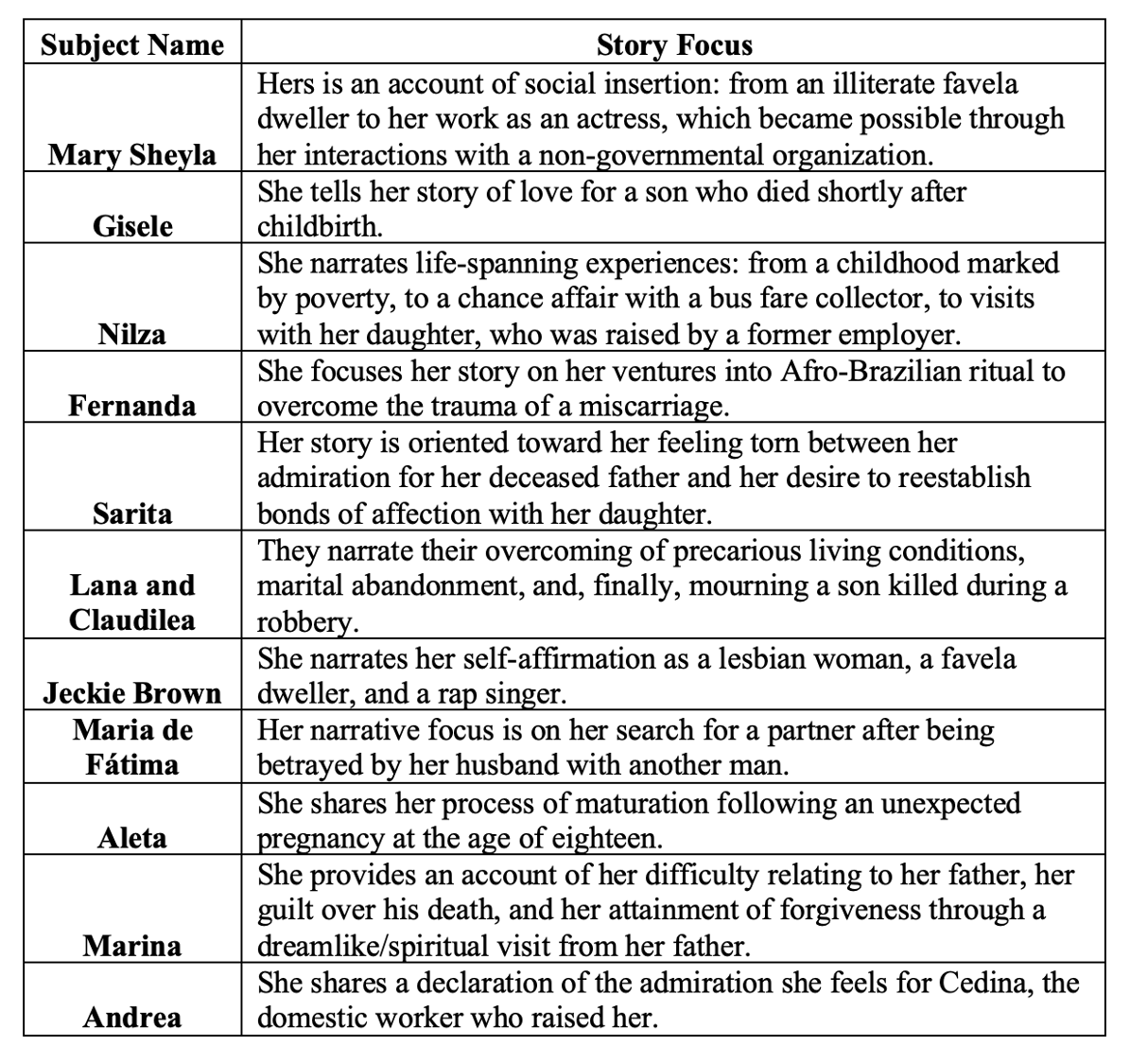
Table 1: Summary of narrative vignettes in Playing
Curiously, this paradox seems to share a common denominator in the exploration of different aspects involved in the construction of the feature film’s melodramatic tenor. The filmic image itself does not vary greatly across Coutinho’s encounter sequences with the participants, but the expressivity of the narrative images is evoked by the spoken word. The critical reception of Playing has referred to this verbal‑corporeal dimension, which is encompassed by the filmic dimension when taking into account mise‑en‑scène and montage. 58 The women are consistently recorded in shots ranging from medium shots to close‑ups, framed with the camera at a normal angle, three‑quarters to the right. The constant lighting highlights the female figures while also casting a faint illumination on the background, where theater seats can be seen, allowing the viewer to infer that the protagonists are positioned on a stage (Figure 2). In addition, the film’s critical reception itself makes reference to the attention paid to the “birth of the word,” 59 a view likewise endorsed by Coutinho himself 60 —and one that can, indeed, be identified in the feature film.

Figure 2: Sample of different framings found in Playing: 00:05:48; 00:01:34; 00:20:52; 00:36:45; 00:42:43; 01:07:05
The consistency of the filmic image and variance in spoken word links Playing to studies on melodrama, namely, three characteristics that are generally identified as central to melodrama. These are anticipation, heightened symbolization, and obviousness. 61 As observed in this study, these characteristics ultimately contribute to an equivalence between fiction and non‑fiction. More directly put, melodramatic filmic narrative is one in which elements are offered to the spectator so that they know the outcome of the characters before the characters themselves do. Expectations are confirmed through an appeal to realist effect. This is precisely what we see at work in the imaginary of the participants (and perhaps especially of the Brazilian audience as Coutinho conceives them). Numerous examples could be cited, but three specific sequences in the film can serve as illustration.
With respect to anticipation, we can highlight Gisele, who, as a “spiritualist,” claims to be “attentive to signs” and who, in a dream, agrees to help a spirit despite experiencing a “pain in her chest,” 62 which later proves to be a bad omen preceding the accidental childbirth that leads to her son’s death. Regarding heightened symbolization, the actress Marília Pêra, despite the restraint of her performance, later tells Coutinho that she nearly burst into tears when recalling the “little face [of her own] little daughter” 63 while playing the role of Sarita, in which she recounted a mother’s experience of estrangement from her daughter. As for obviousness, we can also refer to Sarita’s case. In her second sequence, we have one of the high points of melodrama in Playing, for it is here when she chooses to sing a traditional children’s song, widely known among Brazilians, which had been used by her grandmother, her mother, and her father to lull her to sleep as a child. This, she tells us, was the same song she herself, as an adult, sang to lull her own daughter to sleep. Sarita seeks symbolically to reestablish familial bonds so that her participation in the film would not be, as she herself says, “too sad.”
In all of these cases, it is important to consider those melodramatic characteristics often appear simultaneously in Coutinho’s film. Suffering commonly unfolds through anticipation alongside the verbal creation of excessive and explicit images. Moreover, as noted in typical characterizations of the melodramatic genre, flashback is “almost the narrative itself, and present time [is] a pretext or justification for narrating the action.” 64 That description closely resembles what Playing becomes through the dispositif created by Coutinho, since the main reason the participants take the stage is precisely to share some story publicly (which, as Coutinho comments in the DVD extras, always turned out to be personal in nature). Thus, despite uncertainties regarding enunciation (which might otherwise produce distance between the audience and the work), the stories would still harbor within themselves a “discourse about reality,” 65 consisting of an affective immersion in the private lives of Brazilian women from different social classes. Indeed, within the melodramatic imaginary, the plausible is what provokes affects, expressed in laughter and tears. In this way, melodrama is established through a “pact of intimacy” 66 with its spectators, in which it is only private life (one’s own) that is felt as real. This same imaginary, on the other hand, associates public life with theater, within a tradition in which theater is understood as synonymous with falsity.
In the case of Playing, one cannot fail to recall the constant presence of the red theater seats in the background of the image, continuously reminding the spectator—by means of a filmic procedure—that the stories being shared take place on a theater stage which, once incorporated into the film, casts doubt on the referentiality of the audiovisual images. Thus, a tension is established between the supposed falsity of theater and the supposed truth of “documentary film,” which is how the newspaper ad in the opening shot characterized this work of cinema. In this way, Coutinho arrives at a kind of synthesis in which one cannot say that there is nothing true on the filmic stage. Some truth endures, but not in its transparent form.
In all the sequences, the female figures of Playing are protagonists of stories that retain features of the plots typical of classical Hollywood melodramatic films. From a psychoanalytically influenced perspective, 67 such films bring the female figure to the foreground through a characterization defined by the lack of supposedly masculine qualities (such as courage, leadership, and autonomy—representing, psychoanalytically, the “threat of castration”) and by the assumption of the role of the object of male desire. That is, although the female figure appears to occupy the center of Hollywood melodramatic plots, relegating the man to the margins, what is continuously reaffirmed is the strong presence of the masculine.
With Playing, however, a displacement occurs. The figure of the man is markedly weak within the stories. 68 In general, the men admired by the protagonists are dead, and the others are either relegated to the background or rendered negligible for the narrators. Nevertheless, this diminished presence does not allow us to claim that women are, in fact, at the center of the narratives. What emerges instead is a kind of weak or absent masculine core around which the narratives nonetheless revolve. This hypothesis is reinforced by the mise‑en‑scène itself: the female characters are frequently framed in close‑ups, illuminated and highlighted, while the background at times appears filled with empty audience seats and at other times is completely unlit, plunged into darkness; meanwhile, Coutinho—the only male figure—is briefly captured in profil perdu (Figure 3). The camera’s focus remains fixed on the female character, yet her speech and bodily expressions are always responses to a stimulus provided by the male interlocutor, who is predominantly invisible. A paradigmatic case is the entrance of actress Fernanda Torres in the role of Aleta. In his experimental impulse, Coutinho decides to greet the character addressing Fernanda directly, which breaks the fictional convention of the scene and precipitates a performative crisis, transforming the sequence not simply into an instance of acting, but into the actress’s very process of constructing the character.
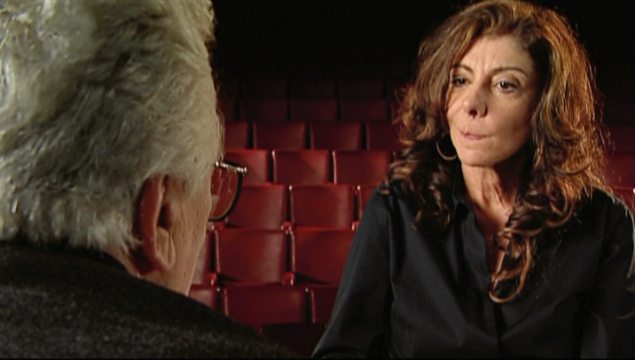
Figure 3: Eduardo Coutinho, in one of his rare appearances in the film, talks with Marília Pêra about her performance as Sarita, 00:47:11.
At this point, once again, it is possible to recall an observation made earlier, in a footnote, regarding Bette Davis, 69 the Hollywood actress who became famous primarily for melodramas of the 1930s and 1940s. A brief review of these films seems to indicate a departure from the Hollywood norm, since, in many of the films starring Davis, the male characters are also marked as a weak presence, albeit a central one. Even so, a specifically Brazilian dimension remains: the mobilization of a popular imaginary that reaches back to the very formation of the Brazilian nation and that is periodically revisited allegorically, whether through film or through other artistic manifestations.
In critical discussions of a Brazilian film with a markedly melodramatic character— i.e., Central Station 70 — scholars have noted the alignment of its plot with a Latin American melodramatic tradition in which the absent paternal figure functions as a narrative engine. 71 The same can be observed in another film by Walter Salles, cofounder of the production company behind Playing. I am referring to I’m Still Here. 72 If, in the first case, the search for the paternal figure is associated with an allegorical search for a national project, in the second, it is linked to the pursuit of democracy, justice, and historical reparation. 73 These films must be read within the broader context of national cultural production. This dynamic, for example, also reverberates in other artistic forms, such as in the lyrics of the song “Língua” [Language] by Caetano Veloso (1984): “My language is my fatherland / And I have no fatherland, I have a motherland / And I want a brotherhood.” 74 This is an allusion to a statement made in the early twentieth century by the Portuguese poet Fernando Pessoa, who declared: “My fatherland is the Portuguese language.” 75 While Portuguese colonizers harbored no doubt about the constitution of their homeland, for Brazilians, what remains is a kind of void—figured in paternal absence and in associated values such as order and leadership. Even so, one cannot deny the existence of a shared sense of origin, of connection to the same “gentle mother,” which does not prevent Brazilians from aspiring to fraternity, to a utopia of a just and inclusive society. This is to say what has been traced thus far, which is to establish that the manner in which melodramatic elements are arranged in Playing mobilize socio‑historically constructed meanings in such a way that the realist effect blurs the boundaries between the fictional and the non‑fictional. This perception, however, is only made possible by a kind of modernist framing that permeates the filmic form of Coutinho’s work.
Situating Melodramatic Elements within a Modernist Framework
Given the identification of elements that make up a melodramatic fictional system—the emphasis on the spoken word; the valorization of the interviewees’ life trajectories (whether through the brief elevation to fame of previously unknown participants or through the stripping away of the veneer of stardom from well‑known actresses); the pursuit of a connection between the affective worlds of the interviewees and those of the spectators through anticipation, heightened symbolization, and obviousness; the elevation of women to protagonism, as discussed in the analysis of the newspaper ad above—a question emerges: would it be accurate to say that Playing is simply one more Latin American melodrama? Once we consider the editing and the minimalist composition of the shots, the answer is clearly no. While the verbal‑corporeal dimension bears proximity to melodrama, its incomplete realization leads the spectator to attend to the very constitution of the filmic dimension that encompasses it, thus revealing a closer affinity with aspects of a modernist aesthetic.
While melodrama plays on the impossibility of separating the fiction constitutive of the participants’ narratives from reality (which would seem to include the experiences of the audience 76 ), it is worth emphasizing that the question posed by the film is not that of fiction versus reality, but rather of fiction versus non‑fiction—that is, between socio‑historically constituted perceptions articulated through narrative, regardless of whether or not they refer directly to reality. The referential blurring produced by the film, however, pushes the question further: it is no longer a matter of what is being referred to, but instead of how reference itself is constructed.
For this reason, among the scholars who have addressed Playing, there are those who argue the film comes closer to the essay form. Among them, Ilana Feldman stands out in asserting that in the essay film “. . . the relationship among word, image, and referent ceases to be immediate; there is always a hesitation between the search for certainties and the impossibility of fixing them, between the will to truth and all the impossibilities of language.” 77 What imposes itself, then, is the enigma. According to Adorno, “. . . artworks are enigmatic in terms not of their composition, but of their truth content.” 78 Indeed, in the case of Playing, while its composition is intelligible, its truth content resists determination, since no meaning is pointed outside the film itself, bringing the work closer to philosophy. For Ismail Xavier, with Playing Coutinho foregrounds “the idea of film as thinking in action,” 79 referring back to Adorno’s definition of the essay as a “form that thinks.” 80 Along similar lines, it is also possible to draw the film closer to literature. To use Adorno’s expression in “Transparencies on Film,” 81 Coutinho achieves, through montage, the composition of “a constellation akin to that of writing.” 82 Consequently, the appeal to literalness—typical of mass communication media (and thus associated with the production of melodramas and a certain audiovisual writing)—fades as the spectator is continually placed in tension between the emotion evoked by the accounts (characterized by a romanticized reverberation constituted by the culture industry) and the reflection on the filmic form itself, produced by the audiovisual resources that make up the feature.
Thus, Playing gives rise to an opaque mode of writing. This approach raises the hypothesis that this is a way of identifying the artistic character of Coutinho’s film which, to recall Nicholas Brown’s point, 83 is suspended from the circuit of mere consumption and, in its autonomy, is opened up to interpretation. This autonomy, however, is not immediately offered by the film in its transparency. It is necessary to approach the work in its opacity, which means considering dialectically the way in which its editing is constructed. This same notion is affirmed in Adorno’s Aesthetic Theory: “Artworks . . . that negate meaning must also necessarily be disrupted in their unity; this is the function of montage, which disavows unity through the emerging disparateness of the parts at the same time that, as a principle of form, it reaffirms unity.” 84
In Playing, two examples illustrate Coutinho’s concern with the positioning of certain sequences between fragmentation and the formation of a unity. First, I mention the case of the film’s first female subject, that of Mary Sheyla, the character who presents herself as an actress thanks to the support she received from a non‑governmental organization. Later, in the seventh sequence, we follow the account of Jeckie Brown, the Carioca rapper. 85 How can we understand the viewer’s surprise when Jeckie de-claims one of her raps in which she spoke about herself and, in so doing, repeats and claims as her own biographical details we had already heard from Mary’s lips in her opening sequence? Was this a mere coincidence, given the characters’ shared social origins? Or, should this repetition be read in light of the experiments staged in the film, in which one of them might be performing the role of the other?
Another case appears in the sixth sequence, in which we follow the story of a woman 86 whose son is murdered during a robbery. The fact that the woman is unknown to the general public does not initially open up the possibility of her being an actress. 87 However, as the film approaches its conclusion, in the twelfth sequence, another woman begins her account, 88 which develops essentially as a transcription of the story heard in the sixth sequence. Such games led Jean‑Claude Bernardet to argue that the film promotes an “autonomization of narratives,” 89 both in themselves and in relation to one another. In the film, Bernardet argues, “discourse speaks to itself,” separated from the “speaking bodies,” since “somewhere in the middle of the film or a bit later, a woman tells her story, but I have already heard that story told a few minutes earlier—who was it that told it again?” 90 In other words, Bernardet situates an intrinsic tension of the film within the dimension inhabited, as he himself puts it, by “speaking bodies”—that is, the verbal‑corporeal dimension. Yet this dimension only exists because there is a filmic dimension which, through montage and shot composition, removes the accounts from their individuality and brings to the fore the socio‑historical background that reverberates throughout the film’s development. The dissociation between body and word alluded to in Bernardet’s reading (2013) thus acquires a new meaning: that of their inseparability and uniqueness at each appearance.
As Adorno states in his lectures on aesthetics, 91 taking up a dichotomy developed by Benjamin, engaging with modern works of art means establishing a tense relationship with artistic objects, for they are characterized by two poles: play and semblance. As play, the gaze turns toward the internal constitution of the work, “not viewed as directly real but placed in parentheses;” 92 as semblance, the gaze turns toward its being‑in‑the‑world as opacity—it “has an intention, . . . it means something, . . . something appears in it which is more than the mere appearance itself.” 93 To read a work, therefore, does not involve simply letting oneself be carried away by it, nor bending it to one’s own purposes, but rather locating a point that allows for an assumption of responsibility in the attribution of meaning between play and semblance. This responsibility ultimately entails a kind of mimesis—not one grounded in transparency, in which the work represents the external world, but another in which the reader’s words must seek a translation for what constitutes artistic form. To consider, as this study proposes, Playing’s filmic dimension as encompassing its verbal‑corporeal one is a way of qualifying the modernist framing of melodrama through a reversal whereby, instead of leading the spectator toward the commodity, the film leads them toward artistic form.
Final Considerations: Melodrama in Playing and Brazilian Peripheral Modernism
By way of conclusion, I would like to briefly retrace the trajectory of this study, which began with partial definitions of realism and modernism—sufficient, however, to situate the peculiarity of cinema, as an art form, within aesthetic debate. This contextualization aimed to frame a discussion of Playing, a singular film within Brazilian cinematography. As has been shown, its critical reception has largely relegated to the margins an aspect that runs throughout the film: the absorption of melodramatic elements. Nevertheless, in making this observation, I do not argue that the film is a melodrama. On the contrary, what emerges is the reflexive nature of the feature, which asserts itself precisely through the incomplete realization of melodramatic effects, even as it mobilizes a popular imaginary. For this very reason—which situates the work within a peripheral context—the reflexivity of modernist origin also does not materialize in the same way it commonly does in European and North American works; this does not signal a separation of Brazilian production from the central modernist movement, but rather a dialectical articulation with it.
It is through its indirect linkage to reality that the filmic form of Playing becomes capable of anticipating developments at the center of capitalism, such as the movement that led, in 2016—almost ten years after the film’s release—to the inclusion of the term “post‑truth” in the Oxford Dictionaries. 94 Through this lens of refuge in what is taken as real today, melodrama—when we consider the filmic dimension—comes to be relativized by the explicit exposure of a mechanism that makes apparent the growing contemporary perception that language is seen as the starting point of truth. Playing thus makes explicit, in its opacity, a movement intrinsic to melodrama as transparency, whose effect is to blur the boundaries between the fictional and the non‑fictional. Gledhill makes a statement of particular relevance to the purposes of this argument: “While the drive of realism is to possess the world by understanding it, and the modern and post-modern explore in different ways the consequences of this ambition’s disillusion, the central drive of melodrama is to force meaning and identity from the inadequacies of language . . . In the face of the limitations of realism exposed by post-structuralism, it [melodrama] operates on the level not so much of ‘Yes, but...,’ than of ‘So what?’” 95
It seems to be precisely from this “so what?” that the audience’s affections emerge, beyond all the estrangements introduced by Coutinho. Moreover, to inquire into these estrangements is to think about the functioning of this very “so what?” The form of Playing ultimately exposes a mode of reading that applies both to cinematic and literary works, since in both cases the relationship between spectator or reader and the work establishes an ambiguous dynamic between personal identification through apparent transparency and the reverberation of a social truth content that resides in the work’s opacity. Herein lies Coutinho’s achievement amid a generation of Brazilian documentary films of the 2000s in which the reality effect derives from identification with a melodramatic imaginary shared around private life. 96 This is a discourse with sociopolitical implications that nonetheless claims to display an inaugural contact with objective reality, thereby producing the prerogative of truth. By universalizing itself as truth, it denies itself as a mere subjective projection of reality.
What has been done here, therefore, is a trajectory that, starting from elements of the film’s verbal-corporal dimension, pointed to a possible popular matrix through which the film is marked by its melodramatic tone, exploring sociocultural and historical traits of the relationship between male and female genders in Brazil. However, this verbal-corporeal dimension only exists by virtue of another—the filmic one—which is characterized by the reflexivity of language in a modernist key. This form, ultimately, not only proves authentic by synthesizing issues specific to the periphery but, by inserting itself into the world system, also shares and anticipates aesthetic and social questions concerning the center of capitalism.
Vitor Soster is a Ph.D. candidate in Literary Theory at the State University of Campinas (Unicamp, Brazil). His research focuses on the relationship between literature and cinema, observing the role of fiction and non-fiction and the ambiguity of cinema between a commodity and a work of art in the process of interpretation. Most recently, he spent a year in a research internship at the Department of English at the University of Illinois at Chicago (UIC) through a fellowship granted by The São Paulo Research Foundation (Fapesp), grant no. 2024/12499-4.
Notes:
-
1 The present work is the result of the rewriting and expansion of two oral presentations delivered in 2025. The first, “Notes on Modernist Features in Eduardo Coutinho’s Playing,” was presented at the 2025 Meeting of the American Comparative Literature Association, held online on May 30, 2025. The second, “Playing and the Brazilian Peripheral Modernism,” was presented at the 2025 Modernist Studies Association Conference in Boston on October 12, 2025. I take this opportunity to express my gratitude to Nicholas Brown, supervisor of my research internship at the University of Illinois Chicago (UIC), for all the guidance received; to Peter Coviello and the entire UIC Department of English for their generosity and hospitality; to Felipe Neves, Chris Gortmaker, Ericka Beckmann, Emilio Sauri, and Pavel Andrade for opening up opportunities to me and for their feedback on my work; to Sibyl Gallus-Price, Marina Vulinovic, Thomas D. Moore, and Joseph Staten for their comments and questions; and to Jared Hackworth and Gaia Penna for their friendship and support. Finally, I thank the São Paulo Research Foundation (FAPESP) for the award of the Research Internship Abroad Grant (BEPE), grant no. 2024/12499‑4. BACK
-
2 Jogo de Cena [Playing], directed by Eduardo Coutinho (VideoFilmes, 2007), 1:45:00. BACK
-
3 Fredric Jameson, “Reflections in Conclusion,” Aesthetics and Politics (London and New York: Verso, 2020), 217-37. BACK
-
4 Frederic Jameson, The Antinomies of Realism (London and New York: Verso, 2015), 5. BACK
-
5 Theodor W. Adorno and Max Horkheimer. “O iluminismo como mistificação das massas” [The Culture Industry: Enlightenment as Mass Deception], in Indústria Cultural e Sociedade. trans. Juba Elizabeth Levy (São Paulo: Paz e Terra, 2002), 5-44. BACK
-
6 Consuelo Lins and Claudia Mesquita, Filmar o real: sobre o documentário brasileiro contemporâneo (São Paulo: Zahar, 2008). BACK
-
7 Christine Gledhill, “The Melodramatic Field: An Investigation,” in Home is Where the Heart Is: Studies in Melodrama and the Woman’s Film, ed. Christine Gledhill, 1987 (London: British Film Institute Publishing, 1990), 26. BACK
-
9 Peter Brooks, The Melodramatic Imagination: Balzac, Henry James, Melodrama, and the Mode of Excess, 1976 (New Haven and London: Yale University Press, 1995), xvii. BACK
-
10 See Sergei Eisenstein, “The Cinematographic Principle and the Ideogram,” in Film Form: Essays in Film Theory, trans. and ed. Jay Leyda, 1949, (New York: Harcourt, 1977), 28-44. BACK
-
11 Sergei Eisenstein, “The Filmic Fourth Dimension,” in Film Form: Essays in Film Theory, trans. and ed. Jay Leyda, 1949, (New York: Harcourt, 1977), 64-71. BACK
-
13 Sergei Eisenstein, “The Structure of the Film,” in Film Form: Essays in Film Theory, trans. and ed. Jay Leyda, 1949, (New York: Harcourt, 1977), 150-78. BACK
-
15 Sergei Eisenstein, “A Course in Treatment,” in Film Form: Essays in Film Theory, trans. and ed. Jay Leyda, 1949, (New York: Harcourt, 1977), 84-107. BACK
-
17 Regarding the coincidence between the names Kino‑Pravda and Cinéma Vérité, both translate to English as “Cinema‑Truth,” Aumont and Marie write the following: “The expression ‘cinema‑truth’ was understood by Morin and Rouch as a reference, in the form of a tribute, to Dziga Vertov’s Kino‑Pravda (then rediscovered by Georges Sadoul) and to the theories of the great Soviet documentarist. This was, however, a misunderstanding, since the Kino‑Pravda were in fact filmed newsreels, named by allusion to the newspaper of the Soviet Communist Party, Pravda (a Russian word that indeed means ‘truth’). The label ‘cinema‑truth’ was quickly abandoned because of its philosophical and ideological ambiguities and replaced by ‘direct cinema.’” In Portuguese: “A expressão ‘cinema-verdade’ foi entendida por Morin e Rouch como uma referência em forma de homenagem ao Kino-Pravda, de Dziga Vertov (então descobertos por Georges Sadoul), e às teorias do grande documentarista soviético. Trata-se, todavia, de um mal-entendido, sendo os Kino-Pravda, na verdade, jornais cinematográficos filmados por alusão ao jornal do partido comunista soviético, Pravda (palavra russa que, com efeito, significa ‘verdade’). A etiqueta ‘cinema-verdade’ foi rapidamente abandonada, em razão de suas ambiguidades filosóficas e ideológicas, e substituída por ‘cinema direto.’” See Jacques Aumont and Michel Marie, Dicionário teórico e crítico de cinema, trans. Eloisa Araújo Ribeiro, 2001 (São Paulo: Papirus Editora, 2003), 51, my translation. BACK
-
18 Benita Parry, “Aspects of Peripheral Modernism.” ARIEL: A Review of International English Literature 40.1 (2009): 27-55. BACK
-
20 Beyond the history of the country itself, we could also consider its traces in the Portuguese language. In Portuguese, demonyms are generally formed with the suffixes “-ano” (América → Americano), “-eno” (Romênia → Romeno), and “-ino” (Argentina → Argentino). Similar cases can be found in English with the suffix “-an” (American; Romanian; Argentinian). However, while in English the demonym derived from Brazil is Brazilian, in Portuguese, one does not say “Brasiliano,” but rather “brasileiro”. Regarding the suffix “-eiro,” Caio Prado Júnior comments: “Portugal’s dependence on Brazil will not end with Independence. A considerable portion of its wealth will still derive directly or indirectly from the former colony, whether through remittances from its nationals residing there or through the return of so many who make their fortune in Brazil. Moreover, Brazil will continue to be, as it always was in the past, a ‘career’ for the Portuguese. Among the alternatives available to him when choosing his livelihood, Brazil always has its place. If he prefers it, he will be called brasileiro [“braziler”], just as he would be called vendeiro [shopkeeper] if he preferred a shop, or merceeiro [grocer] if he worked in a grocery store.” In Portuguese: “A dependência de Portugal com relação ao Brasil não terminará aliás na Independência. Uma parcela apreciável de suas riquezas ainda derivará direta ou indiretamente da ex-colônia, seja pelas remessas de seus nacionais ali residentes, seja pelo retorno de tantos que fazem fortuna no Brasil. Além disto, o Brasil será ainda, como foi sempre no passado, uma ‘carreira’ para o português. Entre as alternativas que se apresentam a ele quando escolhe seu meio de vida, o Brasil tem sempre seu lugar. Se o prefere, chamar-se-á brasileiro, como se chamaria vendeiro se preferisse uma venda, ou merceeiro, se fosse para a mercearia.” See Caio Prado Júnior, Formação do Brasil Contemporâneo: Colônia, 1942 (São Paulo: Brasiliense e Publifolha, 2000), 244. It is interesting to recall that, in etymological terms, “as for semantic notions, the suffix -eiro occurs: 1) predominantly in words qualifying and/or designating men and women who exercise certain trades, professions, activities, etc., which are formed by: a) nouns that designate the product of the work or the material to be marketed and/or upon which the agent’s activity is based.” In Portuguese: “quanto às noções semânticas, o suf. -eiro ocorre: 1) predominantemente em voc. qualificativos e/ou designativos de homens e mulheres que exercem determinados ofícios, profissões, atividades etc., os quais são formados por: a) subst. que designa o produto do trabalho ou matéria que deve ser comercializada e/ou sobre a qual se fundamenta a atividade do agente” See Antônio Houaiss, Mauro de Salles Villar, and Francisco Manoel de Mello Franco, Dicionário Eletrônico Houaiss da Língua Portuguesa, https://houaiss.uol.com.br/houaisson/apps/uol_www/vopen/html/inicio.php/62c/-eiro, Accessed 22 Sept. 2025. In both senses—“career for the Portuguese” and the sense of the noun to which the suffix -eiro is attached—“Brazil” would correspond simultaneously to a market space and to the commodity itself, that is, to the foundation of an activity and to the very product of a work and/or the material being traded. BACK
-
21 Roberto Schwarz, “As ideias fora do lugar” [Misplaced Ideas] in Ao Vencedor as Batatas (São Paulo: Livraria Duas Cidades, 1973), 13-28. See also, Roberto Schwarz, “Misplaced Ideas: Literature and Society in Late Nineteenth-Century Brazil,” Misplaced Ideas: Essays on Brazilian Culture, trans. John Gledson (London and New York: Verso, 1992), 19-32. BACK
-
24 Roberto Schwarz, “Por que ideias fora do lugar?” [Why misplaced ideas?], 2009, in Martinha versus Lucrécia (São Paulo: Cia. das Letras, 2012): 165-172. BACK
-
25 Schwarz, “Por que Ideias Fora do Lugar?,” 165, my translation. BACK
-
26 Roberto Schwarz, “Cultura e Política, 1964-1969,” 1970, in O pai de família e outros estudos, (São Paulo: Cia das Letras, 2008), 70-111. BACK
-
27 For additional context on what normally occurs with melodrama in cinema, see: Gledhill, “The Melodramatic Field,” 27-8; and Laplace, “Producing and Consuming the Woman’s Film.” There is also a mention in Baltar, Realidade Lacrimosa, 13. The author includes melodrama in a group of narratives of excess in which other genres with a commercial appeal can be found such as musicals, pornography, and horror movies. BACK
-
28 Natalia Brizuela and B. Ruby Rich, “An Introduction to Coutinho,” Film Quarterly, 69.3 (2016): 9-11. BACK
-
29 Brizuela and Rich, “An introduction to Coutinho,” 9. BACK
-
30 Brizuela and Rich, “An introduction to Coutinho,” 9. BACK
-
31 Cabra Marcado para Morrer [Man Marked to Death, 20 Years Later], directed by Eduardo Coutinho (CPC - Centro Popular de Cultura da UNE - União Nacional dos Estudantes; MPC - Movimento de Cultura Popular de Pernambuco, 1984), 1:59:00. BACK
-
32 Eduardo Coutinho, “O olhar no documentário: carta-depoimento para Paulo Paranaguá” in Eduardo Coutinho, Ed. Milton Ohata (São Paulo: Cosac & Naify, 2013), 14. BACK
-
33 Brizuela and Rich, “An introduction to Coutinho,” 9. BACK
-
34 Cabra Marcado para Morrer directed by Eduardo Coutinho. BACK
-
35 Central do Brasil [Central Station], directed by Walter Salles (VideoFilmes, Riofilme, MACT Productions, 1998). BACK
-
36 Ainda Estou Aqui [I'm Still Here ], directed by Walter Salles, (Videofilmes, RT Features, MACT Films, ARTE France Cinéma, Conspiração, Globoplay, 2024). BACK
-
37 Carlos Alberto Mattos, “Jogo de Cena: a crença posta à prova” in Sete Faces de Eduardo Coutinho (São Paulo: Boitempo, 2019), 256. BACK
-
38 Beyond the advertisement—as the supposed sole means used to select the film’s participants—the fact that Andrea Beltrão and Fernanda Torres may also be recounting personal stories levels their performances with those of the unknown women who may likewise be telling personal stories. This strategy is one element, among others, that contributes to the construction of a melodramatic effect similar to the prototypical case of Bette Davis, the leading actress in several central Hollywood melodramas of the 1930s and 1940s. According to Laplace, after a generation of film actresses in the 1920s had been represented as “divas,” Bette Davis was presented as “one of us.” Unlike the ethereal nature of the celebrities of the 1920s, Davis appeared as “the product of a fatherless, mother-supported, lower-middle-class family, [the actress] like the heroines of women’s fiction, meets and surmounts adversity because she knows who she is and what she wants.” See Maria Laplace, “Producing and Consuming the Woman’s Film,” in Home is Where the Heart Is: Studies in Melodrama and the Woman’s Film, ed. Christine Gledhill, 1987 (London: British Film Institute Publishing, 1990), 148. Incidentally, similar plots can be found in all the accounts in Playing, whether fictional or not—interpretive developments of this narrative as applied to Brazilian reality are discussed later in the present essay. BACK
-
39 Camila Azevedo, “Jogo de Cena (2007),” in Cinéfila por natureza, 10 mar. 2008, https://cinefilapornatureza.co..., Accessed 4 Feb. 2021. BACK
-
40 Carla Meneghini, “‘Jogo de Cena’ traz duelo entre realidade e ficção,” G1 (26 Oct. 2007), www.g1.globo.com/Noticias/Cinema/0,,MUL154612-7086,00-JOGO+DE+CENA+TRAZ+DUELO+ENTRE+REALIDADE+E+FICCAO.html, Accessed on 4 Feb. 2021. BACK
-
41 Milton Ohata, ed., Eduardo Coutinho (São Paulo: Cosac & Naify, 2013). BACK
-
43 Felipe Bragança, “Jogo de Cena, de Eduardo Coutinho (Brasil, 2007)” in Cinética (October 2007), www.revistacinetica.com.br/jogodecenafelipe.htm, Accessed 4 Feb. 2021. BACK
-
44 Daniel Schenker, “Jogo de Cena” [Playing], Críticos (09 nov. 2007): https://criticos.com.br/?p=1412, Accessed on 4 Feb. 2021. BACK
-
46 In Portuguese: “os personagens foram filmados em junho de 2006, as atrizes em setembro.” BACK
-
47 “O toque de Coutinho é ensejar uma performance que ressalte o que cada um tem de singular, e não o que representa na escala social e no contexto da cultura”. See Ismail Xavier, “A teatralidade como vetor do ensaio fílmico no documentário brasileiro contemporâneo,” Aniki 1.1 (2014): 36, my tranlsation. BACK
-
48 “Se você é uma mulher com mais de 18 anos, moradora do Rio de Janeiro, tem histórias pra contar e quer participar de um teste para um filme documentário, procure-nos”, my emphasis. In Portuguese, the preposition “pra” is an informal and contracted form of “para,” indicating the popular register employed in the ad. BACK
-
49 Maite Conde, Consuming Visions: Cinema, Writing, and Modernity in Rio de Janeiro (Charlottesville and London: University of Virginia Press, 2012). BACK
-
50 Miriam Hansen, Cinema and Experience: Siegfried Kracauer, Walter Benjamin, and Theodor W. Adorno (Los Angeles: University of California Press, 2012). According to Hansen, that period was characterized by “Fordist-Taylorist principles of production … and attendant promises of mass consumption; mass democracy and civil society, that is, freedom from traditional authority and hierarchies, egalitarian forms of interaction, and social as well as sexual and gender mobility (the ‘new woman’ and the alleged threat of the ‘new matriarchy’) . . . [and that of] revues, radio, cinema” (40). BACK
-
51 As we can see, this imaginary is far from being an exclusive phenomenon of the early twentieth century. Beyond Coutinho’s own film advertisement, which resonates with this imaginary, a recent episode in Brazilian cinema that has given renewed momentum to this narrative is that of Tânia Maria, a supporting actress in O agente secreto [The secret agent], directed by Kleber Mendonça Filho (Vitrine Filmes, 2025), 2:41:00, which was nominated for the Academy Award for Best International Feature Film at the 2026 Oscars. Among the actress’s biographical details circulated by the press, particular emphasis was placed on her “progressive and independent mindset,” [“mentalidade progressista e independente”] evidenced by her decision to become a single mother and by her life trajectory—from anonymity as a seamstress in the rural backlands of Rio Grande do Norte to fame attained in old age, even drawing the attention of Hollywood. It is worth noting, moreover, the similarity—keeping the necessary distinctions in mind—between this life trajectory and that of Bette Davis. A certain paradigm seems to be taking shape. See Rodrigo Salem, “‘Vou para Hollywood, se Deus quiser’, diz Tânia Maria, 78, cotada ao Oscar por O Agente Secreto’” Folha de São Paulo (16 Nov. 2025): https://folha.com/8gi46p0k, Accessed on 19 Nov. 2025. BACK
-
52 Perry Anderson, “Lula’s Brazil”, in: London Review of Books 33.7 (31 March 2011): 3-12. BACK
-
53 Incidentally, Coutinho immerses himself in this universe in a feature film produced after Playing. In Um dia na vida [A day in life], directed by Eduardo Coutinho (Independent Production, 2010), the director assembles a chronological sequence composed of scenes drawn from programs broadcast on Brazilian free‑to‑air television over the course of a single day, beginning with morning shows and ending with those aired in the late hours of the night. In this montage, a world is revealed that is constituted by commodities promoted by—and themselves productive of—ideals of gender (masculine and feminine), alienation (sustained by journalistic sensationalism), and fixed social roles (such as that of the child who, when watching a cartoon, is introduced into a social order of questionable values that anticipates those already present among adults; that of the housewife who distracts herself with trivialities while performing domestic labor—amenities that encourage women’s conformity to the space they occupy; that of the father who informs himself through the midday newscast—programming regarded as more “serious” and “informative”; and that of the anguished individual who seeks religious comfort during the night after a day devoted, as the pastor of the broadcast program puts it, to “the vice of gambling”). In short, what A Day in Life foregrounds is a kind of documentation of the omnipresence of commodities and consumption on Brazilian broadcast television, grounded in the logic of celebrity culture, with the continual promotion of the wealthier classes and the reinforcement of conformity to the status quo. One further incident in the film is worth noting: in one sequence, we follow coverage of a party held by the Brazilian elite to celebrate the prosperity of the national economy under President Lula’s government. Coincidentally, while a presenter interviews some of the party’s guests, it is possible to glimpse in the background the passing figure of Paulo Guedes, who would later become Minister of Economy from 2019 to 2022, in the government that implemented the most regressive political program since the country’s re‑democratization. That is, amid prosperous times, the decay was already present. It is through passages such as this that, without any overt intentionality, Coutinho is able to capture movements within Brazilian society. BACK
-
54 Consuelo Lins e Claudia Mesquita, Filmar o real: sobre o documentário brasileiro contemporâneo [Filming the real: on the contemporary Brazilian documentary] (São Paulo: Zahar, 2008). BACK
-
56 The “invitation” of Playing, circulated through media with broad reach such as newspapers and magazines, may activate, in the popular imagination, associations with television segments contemporary to the film, such as Retrato Falado [Composite Sketch], starring Denise Fraga and broadcast by Globo as a comic feature of the Sunday program Fantástico [Fantastic]. According to the network’s website, “directed by Luís Villaça, the actress reenacted true stories sent in by viewers via letter or email. The selected cases were transformed into scripts by writers José Roberto Torero, Maurício Arruda, Mariana Veríssimo, Lícia Manzo, and Marcus Aurelius Pimenta. Viewers then recorded their testimonies, and these accounts served as the narrative thread, interweaving the scenes performed by the actors.” In Portuguese: “dirigida por Luís Villaça, a atriz encenava histórias verdadeiras, enviadas pelos telespectadores por carta ou e-mail. Os casos selecionados eram transformados em roteiro pelos autores José Roberto Torero, Maurício Arruda, Mariana Veríssimo, Lícia Manzo e Marcus Aurelius Pimenta. Depois, os telespectadores gravavam seus depoimentos e os relatos serviam de fio condutor da narrativa, entremeando as passagens encenadas pelos atores.” See: Memória Globo. “Retrato Falado” [Composite sketch] (2022), Accessed on December 12 2023, memoriaglobo.globo.com/jornalismo/jornalismo-e-telejornais/fantastico/quadros/noticia/retrato-falado.ghtml, my translation. It is also possible to associate the “invitation” with segments from radio programs such as the melodramatic Que saudade de você [How I miss you], in which its host, Eli Corrêa, performed scripts created from letters sent by listeners recounting personal stories. See: Luciane Ribeiro do Valle, “Que saudade de você – A construção de uma dramaturgia radiofônica: uma reflexão sobre o quadro de maior sucesso do Programa Eli Corrêa” in IV Encontro de Núcleos de Pesquisa Intercom (2001), http://www.portcom.intercom.or..., Accessed 12 Dec. 2023. However, this universe in which popular imagination takes on the features of mass culture through melodrama has a history that reaches back to nineteenth‑century literary productions—mostly French and English, Romantic and realist. Referring to these, Gledhill states: “Literary and dramatic classics—including Shakespearean tragedies, popular fiction, Romantic poetry and operatic libretti, newspapers and topical events, police journals and penny dreadful, paintings and etchings, popular songs and street ballads all provided material for melodrama.” See: Gledhill, “The Melodramatic Field,” 18. Interestingly, it is within this cultural universe disseminated through pamphlets, booklets, magazine articles, and posters that Walter Benjamin, in “One-Way Street,” discerned the foundations of a modernist literature. Once again, melodrama is not that apart from modernism as the “high culture” appearance may make it seem. See: Walter Benjamin, “One-way Street,” in Selected Writings – Volume 01, 1913-1926 (Cambridge, MA: The Belknap Press of Harvard University Press, 1996), 444. BACK
-
57 David Bordwell and Kristin Thompson, A arte do cinema [Film art: an introduction], trans. Roberta Gregoli (Campinas: Editora da Unicamp, 2013), 366. BACK
-
58 For some examples of publications along these lines, see: Pedro Felipe M. e Baptista Araújo and Luis Antonio dos Santos, “Ética como jogo de cena,” Leitura: Teoria e Prática 36.73 (2018): 105-18. Felipe Bragança, “Jogo de Cena, de Eduardo Coutinho (Brazil, 2007)” [Playing, by Eduardo Coutinho], in Cinética, October 2007, accessed Feb. 4, 2021, www.revistacinetica.com.br/jogodecenafelipe.htm. BACK
-
59 In Portuguese, “o parto da palavra”. See Alexandre Werneck, “Jogo de Cena,” Contracampo: revista de cinema, n.d., www.contracampo.com.br/89/critjogodecena.htm, Accessed 4 Feb. 2021. BACK
-
60 Eduardo Coutinho and Felipe Bragança, “Palavra e superfície” [Word and surface], in Encontros: Eduardo Coutinho, Ed. Felipe Bragança (Rio de Janeiro: Azougue, 2008), 193. BACK
-
61 Mariana Baltar, Realidade Lacrimosa: o melodramático no documentário brasileiro contemporâneo (Niteroi, Rio de Janeiro, Brazil: Eduff, 2019), 122. The translation of these three characteristics into English are mine. BACK
-
62 In Portuguese, “dor no peito”. See Jogo de Cena [Playing], directed by Eduardo Coutinho (VideoFilmes, 2007), 00:10:34. BACK
-
63 In Portuguese: “a carinha da filhinha”. It is worth highlighting here the use of the diminutive in both Portuguese nouns, which ends up emphasizing the actress’s excessive affectionate tone in keeping with the melodramatic imaginary. See Jogo de Cena [Playing], directed by Eduardo Coutinho (VideoFilmes, 2007), 00:47:38. BACK
-
64 In Portuguese: “Quase a própria narrativa e o tempo do presente [são] um pretexto ou uma justificativa para narrar a ação”. See: Baltar, Realidade Lacrimosa, 139, my translation. BACK
-
65 In Portuguese, “discurso sobre a realidade.” See Baltar, Realidade Lacrimosa, 14, my translation. BACK
-
66 In Portuguese, “pacto de intimidade.” See Baltar, Realidade Lacrimosa, 20, my translation. BACK
-
68 A brief review of the major melodramas of the 1930s and 1940s starring Bette Davis—the actress mentioned earlier in other footnotes—seems to suggest a deviation from the Hollywood norm, since in many of the films in which she starred, the male figure is also marked as a weak presence, albeit a central one. The Brazilian specificity of this configuration is developed in the following section. BACK
-
69 I would also like to recall here the life trajectory of the actress Tânia Maria, mentioned earlier. As in the narratives of the film’s participants, the story circulated by the media about the actress’s life aligns with the image of a woman who “succeeds in life” despite men. BACK
-
70 Central do Brasil [Central Station], directed by Walter Salles (VideoFilmes, Riofilme, MACT Productions, 1998): 1:54:00. BACK
-
71 Lisandro Nogueira, “Central do Brasil e o melodrama,” Comunicação e Informação 3.2 (2000): 155-159.; Stephen M Hardt, “Central do Brasil,” in A Companion to Latin American Film, ed. Stephen M. Hardt (Cambridge: Cambridge University Press, 2004), 179-185. BACK
-
72 Ainda estou aqui [I’m Still Here], directed by Walter Salles (Videofilmes, RT Features, MACT Films, ARTE France Cinéma, Conspiração, Globoplay, 2024): 2:17:00. BACK
-
73 Expanding the scope of the research may yield reflections of interest. On the occasion of the event “Varieties of Melodrama: Guru Dutt and Ritwik Ghatak at 100,” organized by Daniel Morgan and Rochona Majumdar and held at the University of Chicago from November 6 to 8, 2025, I had the opportunity to attend screenings of two Indian melodramatic films: Kaagaz ke Phool (Paper Flowers), by Guru Dutt, and Meghe Dhaka Tara (The Cloud‑Capped Star), by Ritwik Ghatak. While Dutt’s film revolves around the downfall of a famous film director, Ghatak’s feature is structured around a plot that follows the martyrdom of a female character who lives among weak male figures (a dreamy and ailing father; adult yet dependent brothers; and an unfaithful fiancé…)—a distinction that could be investigated in terms of its social significance, as in the Brazilian case. In both Dutt’s and Ghatak’s films, there appears to be a resonance with what can be observed in Brazilian film production, in contrast to what film studies have identified regarding the constitution of classical Hollywood melodramatic films. See: Kaagaz ke Phool, directed by Guru Dutt (Guru Dutt Films, 1959), 2:28:00; Meghe Dhaka Tara, directed by Ritwik Ghatak (Chitrakalpa, 1960), 2:06:00. BACK
-
74 In Portuguese: “Minha língua é minha pátria / E eu não tenho pátria, tenho mátria / E quero frátria.” Caetano Veloso, “Língua” [Language], in Velô (Polygram, Philips, 1984), Spotify. BACK
-
75 In Portuguese: “Minha pátria é a língua portuguesa” [My fatherland is the Portuguese language]. Fernando Pessoa,“Minha pátria é a língua portuguesa,” 1914, in Sibila: Revista de Poesia e Cultura (May 2010): sibila.com.br/mapa-da-lingua/minha-patria-e-a-lingua-portuguesa/3601, Accessed on 2 Dec. 2025. BACK
-
76 On the occasions when I was able to attend screenings of the film, the tears of Brazilian viewers were a constant. BACK
-
77 “. . . a relação entre a palavra, a imagem e o referente deixa de ser imediata, havendo sempre uma hesitação entre a busca de certezas e a impossibilidade de fixá-las, entre a vontade de verdade e todas as impossibilidades da linguagem.” Ilana Feldman, “Jogos de cena: ensaios sobre o documentário brasileiro contemporâneo,” PhD diss., (University de São Paulo, 2012), 24, my translation. BACK
-
78 Theodor W. Adorno, Aesthetic Theory, 1970, trans. Robert Hullot-Kentor (Minneapolis: University of Minnesota Press, 1997), 127. BACK
-
79 “. . . a ideia do filme como pensamento em ato.” Xavier, “A teatralidade,” 33. BACK
-
81 Theodor W. Adorno, “Transparencies on Film,” trans. Thomas Y. Levin, New German Critique, 24/25, Special Double Issue on New German Cinema (1981-1982): 199-205. BACK
-
83 Nicholas Brown, Autonomy: The Social Ontology of Art under Capitalism (Durham: Duke University Press, 2019), 8. BACK
-
85 The artistic name of Jaqueline Ferreira dos Santos clearly references the protagonist of Quentin Tarantino’s film of the same name: Jackie Brown, directed by Quentin Tarantino (Miramax Films, 1997), 2:34:00. However, Coutinho’s character, according to the closing credits, has her name spelled with an “e” instead of an “a” (Jeckie rather than Jackie), in a way that approximates the orthography and phonological system of Portuguese. In other words, what might be considered a spelling mistake becomes one of the numerous incidental examples of the peripheral aspect that surrounds both the characters and the film as a whole—that is, a synthesis of Brazil’s cultural positioning in relation to North American culture. BACK
-
86 The closing credits inform her name is Lana Guelero. BACK
-
87 Regarding the recognition of the actresses by Brazilian audiences, Aguilera comments on the marked racial aspect in the film. All the well-known actresses selected are white, and all the unknown ones are Black. If, as the author points out, there is an underlying racism at work, it is important to stress that assuming that an unknown Black woman cannot be an actress may constitute a form of racism on the part of the audience rather than of the work itself. See Yanet Aguilera, “O jogo do mesmo” [The play of the self], in Rapsódia 12 (2018): 79-97. BACK
-
88 The closing credits indicate that her name is Claudilea de Lemos. BACK
-
89 In Portuguese: “Uma autonomização das narrativas.” See Jean-Claude Bernardet, “Jogo de Cena,” in Eduardo Coutinho, ed. Milton Ohata (São Paulo: Cosac Naify, 2013), 634-35. BACK
-
90 “Lá pelo meio do filme ou um pouco mais adiante, uma mulher conta sua história, mas essa história eu já ouvi contar há poucos minutos, quem foi mesmo que a contou? Que rosto? Chega um momento em que o discurso se desvincula dos corpos falantes. Ele passa a existir em si. O discurso se fala a si mesmo.” Bernardet. “Jogo de Cena” [Playing], 627. BACK
-
91 Theodor W. Adorno, Aesthetics: 1958-1959, ed. Eberhand Ortland, trans. Wieland Hoba (Cambridge: Polity, 2018), 45. BACK
-
94 “Word of the year 2016,” Oxford Languages, languages.oup.com/word-of-the-year/2016/, Accessed 26 Sept. 2023. BACK