Back to the Origins of Cinema: Cinema and Its Relationship with Other Arts
Interviewers' Introduction
We caught up with Argentine filmmaker Alejo Moguillansky at a café on a blustery autumn day in Buenos Aires, before he headed out to Paris to film another iteration of “Special Effects” with Grupo Krapp. 1 He had just finished his collaboration on the staging of Philip Glass’s opera Einstein on the Beach at the Teatro Colón (along with Martín Bauer and Léo Warynski). As these suggest, although a filmmaker, Moguillansky travels in an expanded artistic scene in Buenos Aires that includes theater, performance, music, and dance. He frequently collaborates with Grupo Krapp, an avant-garde and heterogeneous group of performers, musicians, and dancers, of which his partner Luciana Acuña is a co-founder (with Luis Biasotto). Along with Mariano Llinás, Laura Citarella, and Agustín Mendilaharzu, Moguillansky is also one of the founders of the independent film producer El Pampero Cine. Founded in 2002, El Pampero has eschewed both mainstream commercial funding as well as state-backed support from the INCAA. By all accounts, El Pampero functions as a collective in which members interchange labor and skills on all projects and in which they frequently shift roles, working variously as editors, directors, producers, scriptwriters, actors, and behind the camera. They have functioned largely as part of what critic Gonzalo Aguilar has called “cine anómalo," 2 a kind of sub-indie scene that runs parallel to the films of the Nuevo Cine Argentino that have garnered so much critical attention in the last twenty years. Notable films produced by El Pampero, in addition to those of Moguillansky, include the 14-hour film La flor (2018) by Mariano Llinás and the 4-hour-and-20-minute Trenque Lauquen (2022) by Laura Citarella, which won best film from Cahiers du Cinéma in 2023. The recent success of Trenque Lauquen has brought greater international attention to El Pampero, including the recent dossier, 22 years of El Pampero Cine in Senses of Cinema. 3
Moguillansky’s own films have shown in festivals at Locarno, Berlin, Vienna, London, and Cannes and have won the award for the best Argentine film at the BAFICI (Buenos Aires Festival Internacional de Cine Independiente) three times with Castro (2009), El escarabajo de oro/The Gold Bug (2014), and La vendedora de fósforos/The Little Match Girl (2017). His films are characterized by blurring the boundaries between documentary and fiction, such that El loro y el cisne/The Parrot and the Swan (2013), for example, begins as documentary recordings of dancers rehearsing for a performance, recordings that were then repurposed in a fictional context. His films are also marked by intertextual literary dialogue: La vendedora de fósforos/The Little Match Girl (2017) is organized around the well-known Hans Christian Anderson story; La edad media/The Middle Ages (2022) is staged partly in relation to Waiting for Godot; El escarabajo de oro/The Gold Bug (2014) bills itself as a rewriting of Stevenson’s Treasure Island and Edgar Allen Poe’s “The Gold Bug.” Jorge Luis Borges is also a clear influence on his cinematic poetics. Besides the presence of literature as an intertext, a constant feature of his films is the presence of other arts (e.g., dance, music) competing with the language of cinema, as well as a preoccupation with the scarcity of money in the independent art scene and the fact that all artists are also workers. We touched on all these topics in our interview with Moguillansky as well as reflections on his latest projects and the evolution of his cinematic practice. A notable thread in our conversation was the challenges posed by an increasingly dominant language of television and its effect on cinema and the possibilities for cinema’s resistance in today’s world. 4
Interview with Alejo Moguillansky. May 17, 2024
Adriana Johnson (AJ): A central gesture that interests me in your films is their relationship with other arts, especially dance and music. It seems to me to have two aspects, which I tried to separate but which cannot be separated. First, a formal relationship to the arts, a formal relationship in the sense that you open cinema to these other forms. Second, this opening, or relationship, or contamination happens because they are all forms of work and they all depend on money. You point out how dance, music, and cinema depend on forms of financing, how they are all forms of work, and in your films, you show this work. So, I’m interested in understanding the place of cinema in relation with these other arts for you: is it one medium among others or is there a privileged place for cinema in showing art as labor? I am thinking, for example, of [Dziga] Vertov and his The Man with the Camera (1929). There the camera is attributed with a privilege as the mechanical eye that can see and reveal things about the social totality precisely because of the mechanization of the eye. Insofar as the eye is related to industrial production processes it is also a way of looking at those production processes and the forms of relationship comprising labor. But I think Vertov’s films are more visual than yours since there are moments when your films are invaded by the movement of the bodies, when dialogue ends up being more important than what is seen, when music ends up being the main form and the camera seems secondary, or just one medium among others.
Alejo Moguillansky (AM): I don’t know if I have a very clear answer.
That is to say, on the one hand, there is a longing to transcend cinema from within, like planting oneself in the heart of the language of cinema in order to destroy it, or the idea that one could re-found cinema in each film or from each shot. There is the feeling that with each step cinema has to remake the entire architecture of cinema and the question is: how do you show that? In that sense, yes, it seems to me that there is a small gesture in my films that has to do with the idea of cinema going out again to conquer other arts.
Cinema was always capable of conquering opera, ballet, music, theater, etc. Cinema has always had that ability to appropriate things, to become other. So, this idea of transcending cinema has to do with being able to film theater without being theatrical. It is the question that [Jean] Renoir asks himself all the time. In fact, he goes so far as to say that, “Well, I have to show the entire proscenium (stage) if I film theater. If I put the camera on the stage there is a problem.” It seems to me that this ambition to conquer or to become other has to do with cinema’s capacity to bear witness for the other. I mean, cinema has always known how to conquer other arts, but it has never been able to conquer television, with some notable exceptions. It’s the reverse, you see?
Cinema gives ground before television. One sees it today in a brutal way, that the entire language of cinema today is the language inherited from platforms like Amazon, Netflix, etc. It is the language that comes from television, it does not come from cinema... In that sense my gesture is a somewhat melancholic, small political gesture, to say well, let’s go back to making a cinema that can confront everything, even television, and not one that is ceding ground. On the one hand there is that.
On the other hand, there is the idea of constantly leaving cinema behind, surpassing it, of being able to do something that betrays itself, that has no respect for itself and that can become dance, for example. But the question is how to ensure that a scene where the main theme is a dancing body does not become a theatrical scene from the world of dance. How to ensure that a scene that has a very strong literary imprint doesn’t sound like something that is just being read, something pompous, solemn, etc.? So, that’s where it seems to me that distance plays a role. How do I incorporate literature into film? Well, not by mixing it with cinema but by filming literature, filming the idea of literature itself and letting words take on a brutal, omniscient and omnipresent meaning. And so, it seems to me that moving closer to other arts implies dismantling cinema, like killing the language itself. The idea of editing is present there: it is in friction where one sees meaning.

Image 1: Hunting Day
AJ: But I feel that in Día de caza/Hunting Day (2019) 5 which I read as a struggle between two mediums, dance and cinema, your film becomes dance. Rather than cinema conquering dance, it seems rather that cinema is being swallowed up by dance, transformed into dance. I found it a fascinating experiment. Is that what you mean when you say that cinema betrays itself, that it turns into something else?
AM: It goes in search of other languages to broaden its own. When you see [Harold] Lloyd’s slapstick, that feeling of dance is always there. Buster Keaton is a dancer; Buster Keaton is nothing other than a dancer. So, there is a kind of return to old cinema. Cinema was really born like that. Cinema was not born intelligent: it was born popular; it was born plebeian; it was born unconscious; it was born innocent. And in that sense it is like trying to get back to that place. How to still believe in a certain capacity of cinema in which it is like the spectacle at a fair, a magic show... That is what is interesting about cinema. It’s not that films are intelligent, that they say what you want them to say, which is what happens with cinema today.
AJ: Can you say a little more about how you understand the language of television? What is the language of television that for you is invading cinema? I don’t know if I understand exactly.
AM: It seems to me that there is a format that has to do with a certain supremacy of the plot, where the stories are completely verbo-centric. The plot dominates, there is no idea of anything outside the plot … If you look at Netflix or the films that are already designed to be projected on the little screens in an airplane, the long shot is no longer an option, the full body shot is no longer an option. They are all films that go from the medium shot to the close-up. They are totally verbo-centric and depend completely on the plot … Well, that’s what we call television.
Gabriela Copertari (GC): Sure, where the image is subordinated to the development of the plot. On the other hand, it does not make us aware that we are watching a movie, which is precisely the opposite of what happens with your movies where you are always aware that you are watching a movie.
AM: That comes from the language of the platforms. In fact, when you produce for a platform for example, there is a control mechanism exerted on the script in your hand like... on page 30 something like this must happen, on page 60 something like this must happen, on page 45 there should be a plot twist in this way, etc. And there is a kind of board of script doctors who are there to homologate the films a bit. Even the most resistant cinema today is also very verbo-centric.
The world has become so extreme in the present we all live—with the advance of right-wing governments, of libertarians now in Argentina, but in Europe too—that the discourse that combats this in cinema is just as discursive as the other discourse. Because the other discourse is directly committed to making cinema disappear. In that sense, well, non-discursive cinema’s small place of resistance is already a sacred temple that no one remembers, a left that no one cares about anymore. But I confess that I care about it a lot.
AJ: Let’s see if I understand what you are saying by discursive or verbo-centric … In your films there are many scenes where dialogue is so important, where in fact it is the most important thing… It may be that they are dialogues that do not have a clear utility, there is not much information given through the dialogue, the dialogue is there to do something else...
AM: But it is not more important than the editing, it is not more important than the music, it is not more important than the affective state of a certain actor, it is not more important than the movement of the camera. It is one more thing, something that one cannot say about most films, which are films that are explained to the audience.
GC: One might think that the dialogues do not seek to convey an idea but often give the sensation of unreality. For example, Walter, in El escarabajo de oro/The Gold Bug (2014), 6 doesn’t seem to understand anything and suddenly he says something that makes him seem very erudite and doesn’t match what the character seems like up to that moment. In other words, they are unrealistic dialogues.
AM: They are non-naturalistic.
GC: They are non-naturalistic. They sound as if they were written sometimes...
AM: And there is also a kind of game in which you see the person all the time and the performance all the time and finally the character is a bit of a mix of those two things. It’s like the process of Joan of Arc by [Robert] Bresson in which suddenly there is an actress repeating a text, that of the trial of Joan of Arc, and the thing to see is that actress saying those texts, as if they were two separate entities, and we create a montage of those two entities in our head or in our emotions.
I think there is something of that here because the characters in my films are certainly not psychological characters. They are characters, yes, and they are real people, yes. You see, for me, Luciana [Acuña] in my films always has a very energetic presence, and it’s Lu, it’s not very different from Lu, that thing that’s there in the movies. It’s her. And the film goes in search of that. It is the famous record of reality, right? It starts with a documentary imprint and then goes in search of fiction, but that fiction that is sought is a kind of mutual contract among various parties, among the actors, the director, and finally the person who sees the film. It seems to me that all the cards are out there. So, what these films try to do is construct a fiction. But they try to do that with all the mechanisms in full view. It’s about building an image. But I insist on the idea of a contract in the same way that a contract works in genres. When you go to see a particular genre, you already know what you have to do, how to behave as a spectator. Well here, since these films are not genre films, they have to make those rules explicit and if everything is fine, move on, but the contract that is established is very clear.
AJ: You return many times to the example of a person on screen dying, a scene that starts to become something like a dance. I think of it in as a stretching, like an expansion, like an abstraction of something that is real, which is a body moving in space, and you push it a little bit and it starts to look a little strange and that’s where fiction comes in, where you can see it in another way, as something more abstract … with all the materials in full view, as you said, you stretch towards a place where it starts to be a little strange, more like fiction ….
AM: Well, but this is an attitude very typical of musical development, you see? As in the sonatas, theme A, theme B... well, let’s see what happens as it develops and if something is constructed. And sometimes when it’s not put together well, nothing happens. But when it does work, you witness a thing, a creation, something that comes together there in front of your eyes. I think my movies have that attitude. They try to make something come together in front of us all, and one can trust the act of creation, the act of magic we all witness. And if it happens it means the film is good, and if it doesn’t happen it means the film is not good.
In this sense, it is almost like the films operate with a category of sincerity. They can fail, and maybe not everything turns out well, but there is also a lot of work and concern in preserving the documentary gene of certain materials, of not forcing it from the first minute but pushing it step by step, little by little, so that finally what is told in those films is the story of their own gestation. Not that the film is documenting itself, but more the idea of, “let’s work as a group, let’s see if something comes out.”
AJ: Sure, self-documenting often implies that everything has already been done and you are simply documenting it, but what you see in your films is the act of creation itself. Now I understand it better. I was relating the idea of fiction to money, because money is a fiction that dominates everything, but, in any case, it is a fiction. But I think you’re going the other way.
AM: Money is always also mediating.
AJ: It’s almost like [your films are] anti-money, because money tries to cover its tracks...
GC: You said that you were trying to make cinema conquer other spaces (such as literature or other arts): not domesticating them but rather showing them in their specificity, so to speak. In that case cinema would not have a privileged place, and there would not be a hierarchy between all these arts … In other words, this is what Adriana was asking, does cinema occupy a privileged place or is it just another medium among all these arts that mix...
AM: What do I know? I have no idea! For me it is privileged!
GC: Oh, yes? Then it would be a bit what Adriana says about the mechanical eye, which represents the work process, both its own and that of the other arts.
AM: Cinema always has the gift of registering. Cinema is always a document. It is a kind of machine that never stops, that will continue filming... You can die and the camera will continue filming. That’s impressive about cinema. You can film your own death. That doesn’t exist in other arts. It must be said that this capacity to register is a privilege in itself. That’s very impressive, like some kind of strange device that can see beyond you, and then can see beyond everyone. That mechanicity makes it an entity... In this sense it seems to me that there is no point of comparison between cinema and anything else.
AJ: When I rewatched all your movies together, I felt that there was a shift in your latest movies. Just now when you said this, I was thinking about La edad media/The Middle Ages (2022), 7 which I love, especially the ending when you compare cinema with money, because of the fungibility, the exchange-value of money. And I had the idea that until now cinema was always on the side of work. It was a way of doing things, and money was always scarce, and cinema was always running after money. And suddenly in that film, I felt that, well, cinema was suddenly on the side of money. It was operating like money, transforming and killing the world, because it was abstracting, digitizing, transforming everything into numbers. So, I don’t know if I’m imagining that there’s a change there or that you’re just perhaps thinking about the mechanics of cinema in a slightly more negative way now.
AM: It seems to me that it has to do with that idea that we talked about before, of cinema yielding before the language of television.
Also, obviously, there is a certain nostalgia for that old celluloid thing... the idea that in celluloid light enters and chemically molds itself to the material whereas the chip expels the light, makes it bounce back. So, [the chip] is a kind of intelligent machine interpreting a language that is not its own, and which interprets light as it might interpret music. But you can’t explain everything with zeros and ones, right?
There is this idea of the permutability of numbers, as they say in The Middle Ages, but also a kind of small gesture of resistance in the film. Not everything can be exchanged by a binary code. There is something of that and there is also something of the use given to cinematographic images on social networks, that almost utilitarian use of the gif, where images already have a pre-opinion. Someone attached a meaning to them and it has a kind of exchange value, right? One has to react to an image. Why do I have to react to an image? As if one had to react to a painting! I don’t react to Caravaggio! I don’t give a thumbs up to Caravaggio! Because I have to react, you understand?
There is a new economy of images that is suspect and that cinema has to flee. It seems that the end [of The Middle Ages] has more to do with the fact that cinema in the present is so permeated by that idea of use value and every image, every object, all the world that enters into cinema... well, is condemned to that fate.
GC: What interests me is the relationship between your cinema and literature, especially Borges, whom I really like...
AM: Me too!
GC: Because there are characteristics of your cinematic poetics that we also find in Borges’s poetics, such as the idea of combination. Borges’s poetics have been characterized as an ars combinatoria, in which the important thing, as Beatriz Sarlo would say, is not the invention of something new but the combination or rewriting of pre-existing materials, of other people’s texts, in contrast to the falsity of that representation that claims to be realistic. So, we are moving away from realistic representation, realistic here also in the sense of the television’s aesthetics you were depicting earlier.
AM: Borges is always there. There is that phrase by Borges: “I am not the books I wrote but the ones I have read.” This idea is interesting because one is a kind of door that can be opened and a film becomes a place for a lot of other films to enter, a lot of other materials that have no reason not to be there, right? It would be stranger for them not to enter a film. Because if you like Renoir so much, why can’t a Renoir soundscape enter your film?
GC: I am interested in your work with literary texts as intertexts, for example, Stevenson and Poe in The Gold Bug; Waiting for Godot in The Middle Ages …
AM: What happens is that these materials are a starting point where you begin to think, or work, or film something without any horizon, so the film is born as a possible variation of that material that is going to experiment a kind of development. It helps me a lot to think about the idea of reverse shot. So, for example, what’s the reverse shot of Waiting for Godot? What is it? Is it an Argentine artist making Waiting for Godot? Is it Godot? Is it a dog looking at that? To think about the idea of reverse shot as a kind of place, almost of editing, of editing between two images which is above all what cinema is made of. This, and not the script, is the starting point of a film.
In fact, I am not interested in writing scripts, and the presence of all those materials that you enumerate has to do with my apathy. I often feel like an idiot writing a script. You write “Scene one. María …”? Who is María? What is the police station? What does “Exterior. Day” mean? You don’t know the place. You don’t know who María is. It feels ridiculous.
When you start with the camera you don’t ask yourself all those questions. You find the first image. Then the process of thinking about a second image from this first image is much more organic and this is where the idea of reverse shot and of a properly cinematographic writing, that is not scriptwriting, begins to work because it is through editing that one thinks and writes while filming and while editing. So, in this process the exercise is more similar to that of a documentary filmmaker who is working as if everything in front of him were fiction.
One realizes finally that there is not much difference between fiction and documentary, which is an old distinction. One films fiction and documentary in exactly the same way. The difference is that in one case it happens if you make it happen and in the other it doesn’t. But in terms of framing, it is honestly the same. One is a creator of images, and in front of oneself is the world, in that world there is Stevenson, there are treasures, there are musicians, … so there, I mean, it is much more organic than one believes. It is not a gesture of doing something, like, “I am going to intervene, make this, this, and this come together here.” There’s a bit of play with that too.
There is also a very Borgesian thing about appropriating other people’s goods and making them your own. Borges’s idea is that Stevenson is Argentine, Stevenson is ours. So, of course, there is that trust there, but it is less the speculation and the gesture than the organic idea of having a general shot and putting everything in it. There is the book, there is the stereo, there is the dog, there is... it’s all there.
GC: Editing is what allows you to put all these dissimilar materials together.
AM: Yes, one can also think about those films that obviously have such dissimilar elements, and that the film is the one responsible for putting them together. What a film is really telling is how those materials come together.
GC: Sure, and it also shows it, it shows the sutures.
AM: It’s almost like a bricolage, but live: there you put everything together. Like that nice phrase by Godard about “connecting distant points.” Montage is that. It is joining points that one wouldn’t think fit together, and the less sense it makes, the better, because if not, it quickly becomes irrelevant.
GC: The other thing that can be found both in your poetics and in Borges’s is the intent of producing a permanent cultural decentering: that mix of languages, of cultures, which one can find in both.
AM: Yes, we owe that to Borges. It’s a kind of completely Borgesian idea that literature opens up all the time... Of course, there is a somewhat anti-nationalist feeling there too of always wanting to escape from the path of costumbrismo. 8 But from then on, why can’t you put Copenhagen 1893 next to Buenos Aires 2013? 9 In any case the question is how to place them together and the answer is that, instead of naturalizing it, it must be done with forcefulness and arrogance and finally with humor. There, the idea of a contract comes back. If the caper works, you can continue on. That’s what you learn from clowns, see? The clowns know that in three minutes they can make you laugh. So, the first joke comes in, the second joke can tell you whatever it wants, and then, you’re already there. So, it’s a bit of that thought: well, let’s see, on our side there is humor, there is arrogance, there is narrative impunity. Let’s use it. Let’s not try to naturalize anything here. And that is why it seems to me that one is so far removed from naturalistic language and any type of verisimilitude. But when Borges says that, he says it precisely because Borges does not work with psychological characters. He does not work with the idea of verisimilitude.
And it seems to me that there is also a use of paradox at all times. A paradox is not bad. It’s what allows you to move forward. And if meaning constricts [the film] too much, then you start to clip it a little, like the wings of a story. As long as there are questions or paradoxes or abysses... the film is open to incorporating more materials. They are stories that open outwards: it is the ideas that come after the images and not the other way around, right? And the more contradictory those ideas are, the better. In fact, that’s what conflict is made of: the idea of conflict is that very thing, and not a commitment to a particular idea. But that also has to do with the idea of not making a very discursive cinema, films that are excessively thematic or excessively agenda-driven, films with which everyone agrees and of which everyone says: what a necessary film.
Which is a bit of a death too, those canonical films...
AJ: I would like to go back to this idea of cinema as a magical spectacle, because this performance that you are going to do now in Paris [“Special Effects”], as well as your work in Einstein on the Beach... really stages the film editing process as if it were a performance. It’s always implicit in your films, but now you are doing it openly. It is a new development to stage cinema as if it were a magical show like any other. And see what happens. Because I imagine that at any moment it can not work or something can fail just as anything that is live...
AM: Yes, what happens is that there is a theatricalization of cinema and of the set in all my films. My films are always a kind of delirium where you have to go out and film with two cameras, where one is a prop and the other is not... That happens all the time.
AJ: But in these performances there is no subsequent montage process; montage is what is happening at that moment of performance, of enunciation.
AM: When it’s live? Yes, of course...
AJ: It’s almost like going back to the origins of cinema.
AM: It is the place where cinema is still noble. Something other than going to Universal Studios to see the extras, the stunts, to see how they kill themselves there in front of the audience. What is played out there is the idea of realism, of things happening, that it is not via effects. It seems to me that if you are really willing to generate images that surprise you, you have to create a kind of framework, a context to be able to invent an image.
Mariano’s film [Mariano Llinás’s] La flor/The Flower, for example, was a 14-hour movie that was like its own festival, which already invited a kind of experience. The idea of theatricalizing the set a little seems to me to have a little to do with that, with being able to frame an image through a film crew. It also has a lot to do with my kind of narrative and of the Pampero in general: stories within other stories and another one within another... that game of Russian dolls is finally what you begin to work on in a poetic intensity together with a spectator because... we go together to see “what’s inside this?” and “what’s inside this?” and “what’s inside this?”
In that sense, the idea of the film set, that kind of obsession, works a lot in that direction, like creating a framework so as to be able to create inside freely without narrative, moral or bureaucratic obligations. I think it has a lot to do with the idea of being able to create a kind of tabula rasa all the time. It takes a lot of work to frame that so as to be able to see it.
AJ: It’s interesting because the image of the Russian doll projects a going inside but in some sense the image of creating the frame is almost like going ever outside to create a bigger frame each time.
AM: Often the first thing one creates is inside everything and then one moves outwards from there. That’s what happens to me. I start with something that is the most abstract and that I know has brutal poetic intensity and then I wonder how I support this to make it the heart of a film. I work like that. I go outwards, I don’t go inward, but then you start moving back inside again.
It is like painting: you paint something that no one will understand unless you explain it, so it is like a kind of explanation work. For example, in Por el dinero/For the Money (2018) I was sure about the Asterix scene in the movie. 10
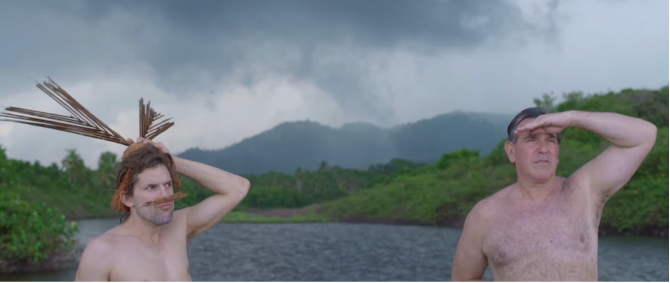
Image 2: For the Money
That is the scene that moves me, that wrecks me. It has a level of intensity that moves me because I am a kind of an insane Asterix fan, and because I was watching those two adults as two almost mentally-challenged adults playing Asterix in the mountains, which was always the driving force of the entire film. I can name a similar moment for each film.
AJ: And in The Middle Ages?
AM: In The Middle Ages there is the scene of Luis, the scene of that kind of fumigator who enters the house. There are two scenes in The Middle Ages that play that role a bit, that are connected. The truth is that one is within the other. One is the scene of Lu dying, with Cleo chasing her. I knew that something had clearly been touched on there, and it had to be the heart of the film. How to make that game between mother and daughter a tragic scene with the help of literature and music, of course. How to make that game turn into something dangerous. [Samuel] Beckett and Tom Waits are there. That was one scene. The other scene is that of the kind of fumigator who comes with smoke. In that strange scene the character is Luis [Biassoto]. Luis was Luciana’s partner in Krapp and died shortly after this scene.
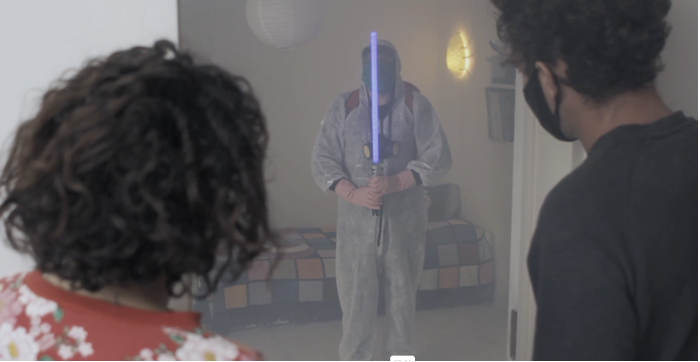
Image 3: The Middle Ages
He died 3 years ago yesterday, May 16. A tragedy. Luis was like Lu’s brother. They co-managed Krapp for 20 years. They worked together in everything they did: at the university, in the works outside of Krapp, inside Krapp, in Krapp’s duo. They were very close. And Luis suddenly died and that scene became sacred. Besides, in this scene, the character dies. That character disappears. As always, I have the idea that cinema has a kind of possibility or almost obligation of documenting. Cinema is a document. You film someone, and, above all else, that is a document of that person.
And the good thing is that it is a document through fiction, not a journalistic chronicle. When you document the best, when you are best able to trace someone’s passage through the world, it is through fiction. Rembrandt’s paintings are always very useful to me, those late paintings where he painted himself dressed as a Tsar, which are so fragile... All of Rembrandt’s late paintings are impressive. They are very somber and the entire mise-en-scene has a high level of theatricality. No one who looks at that can say that that is not fiction. That’s fiction. At the same time, you see Rembrandt painting self-portraits over and over again. They are all self-portraits. They are very moving. And it seems to me that cinema has something of that too, that through fiction it manages to very faithfully show someone’s passage through the world.
So, that had happened with Luis and we were portraying Luis’s last performance. So it became a very sacred scene and there I fully understood the idea of a portrait. Because when the film was released, Luis was not there, and we were showing his last performance. And then you realize that you are always filming someone who is going to die. Then, suddenly, you think about the shot again, as something that you have to remember all the time.
Notes:
-
1 “Special Effects” is a site-specific dance/performance by Grupo Krapp presented in various cities (Cádiz, Buenos Aires, Paris). The performance consists of filming an extended dying sequence of a dancer/performer in one long tracking shot. This is done in the middle of the city in full view of passersby and is accompanied by special effects such as rain, snow, colored smoke. The public both accompanies the filming and cinematic tricks that create the special effects and can also see the final result on a large screen installed in the city. See https://proyectoidis.org/efectos-especiales-performance/ BACK
-
2 Gonzalo Aguilar, Más allá del pueblo: Imágenes, indicios y políticas del cine (Buenos Aires: Fondo de Cultura Económica, 2015): p. 14. BACK
-
3 See 22 Years of El Pampero Cine. Dossier in Senses of Cinema, August 2024, https://www.sensesofcinema.com.... BACK
-
4 The interview was conducted in Spanish. We translated the text published below in consultation with Moguillansky. BACK
-
5 Día de caza/Hunting Day (2019) is a short film about the tragic encounter between two groups: a group of tourists on vacation characterized by frenetic movements and a group of “swamp monsters” with guns who go out hunting. While all characters simulate speaking, the film is essentially non-verbal. BACK
-
6 Moguillansky’s The Gold Bug is the film that has accrued most critical acclaim and commentary. It is the result of an initiative of a Danish Film Festival, CPH:DOX, which proposed bringing together two directors (one European, one non-European) to co-direct a film. In this case Moguillansky collaborated with Swedish director Fia-Stina Sandlund. The Gold Bug takes the form of a fictional documentary following the purported attempt to make a film about the Argentine political figure Leandro N. Alem even as the Argentines try to hunt for treasure under the pretext of the film. BACK
-
7 The Middle Ages was filmed in Moguillansky’s home during the Covid-19 pandemic and follows the story of himself and Luciana’s attempts to continue to make art (to film, to dance) even as their daughter creates a successful scheme to sell off their possessions in order to buy herself a telescope. BACK
-
8 Costumbrismo here refers to a genre in the Hispanic world emerging in the nineteenth century that focused on depicting local customs and characters. BACK
-
9 The Gold Bug begins with Fia-Stina Sandlund’s proposal to make a film about nineteenth-century century Swedish author Victoria Benedictsson but filmed in Buenos Aires. The Argentines counter that this is to use Argentina merely as a cheap backdrop for a European film, and they propose a film about Leandro N. Alem instead. BACK
-
10 Por el dinero (2018) is a filmic extension of a performance (by the same name) in which Moguillansky and Acuña address the financial troubles that followed the making of El escarabajo de oro. The film presumably follows the story of a performance troupe that goes to a festival in Cali, Colombia to present “Por el dinero.” Their plans to stay afloat financially go awry, and Moguillansky and Acuña end up dead on a beach. The Asterix scene Moguillansky references takes place near the end of the film as the troupe flees the police and finds themselves stranded for an indefinite amount of time on what seems to be a deserted island. Listless and bored, they while away the time by telling stories, singing and playing games. As the 7-year old daughter of Moguillansky and Acuña reads an Asterix comic book, the four adults are shown playing out a medley of scenes from Asterix (including Asterix and the Great Crossing and Asterix and Cleopatra), either in her imagination or to entertain her. BACK